
Table of contents
- What does Mainlining mean in cannabis cultivation?
- Botanical basics: Why symmetry matters
- Mainlining cannabis: Which setups does it make sense for?
- Difference from topping and fimming
- Guide for mainlining
- An often underestimated factor – pot size
- Genetics and plant material
- Effort, time, and realistic expectations
- Typical mistakes with mainlining
- Legal classification (Germany, as of 2025)
- Summary of mainlining
Mainlining is one of those training methods that often comes with high expectations. But it's not really a “trick” for quick results. It's actually a targeted approach to plant architecture. If you understand Mainlining properly, you'll quickly see: The key is in guiding the plant to develop a symmetrical, evenly nourished structure.
This article explains what Mainlining in cannabis cultivation means, why the method can work, and what role pot size, genetics, and growth phase play. We'll also talk about where its limits are. So, let's get started.
What does Mainlining mean in cannabis cultivation?
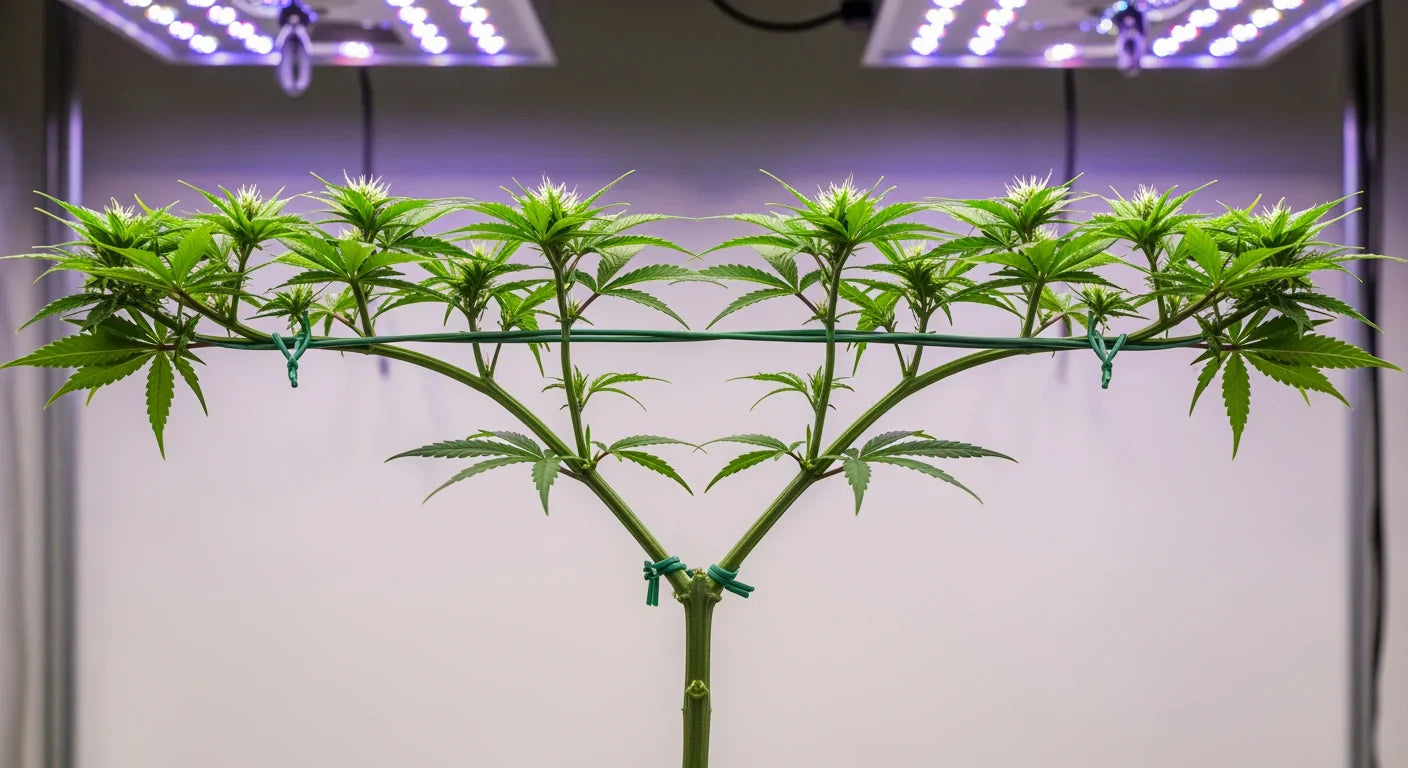
Mainlining – often called the Manifold technique – is a training method where the plant is guided early on so that all future main stems grow from a single, central point.
The goal is a plant with equal main stems, identical distance from the root base, and a uniform supply of water, nutrients, and light.
Unlike natural growth with a clear main top, apical dominance is intentionally broken. The result isn't a single dominant top, but several structurally similar stems. Mainlining isn't a guarantee for higher yields, but a tool to optimize plant structure.
Botanical basics: Why symmetry matters
Plant growth follows clear physiological rules. Hormones like auxins make sure that growth focuses mainly on the top shoot. This principle of apical dominance makes sense from an evolutionary perspective, but it works against an even plant structure.
With mainlining, this mechanism is deliberately interrupted. Growth is redistributed, side branches develop more evenly, internodes become more similar, and sap flow is balanced. The goal is a balanced architecture, where no stem is structurally at a disadvantage.
Especially when space is limited or under artificial lighting, this uniformity can be crucial for making the most of your available area.
Mainlining cannabis: Which setups does it make sense for?
Mainlining cannabis is especially suitable for setups where control is more important than speed. Typical examples are
- Indoor grows with limited height,
- projects focused on an even canopy
- or the use of genetically identical cuttings.
This method is less suitable for very short vegetative phases or sensitive plants. Automatic flowering varieties also often don't respond well, since they have little time to recover.
The basic requirement is always a healthy, vigorous plant like the ones you'll find in our online shop. Without a stable foundation, mainlining leads to stress, not structure.
Difference from topping and fimming
Terms like topping and fimming often come up alongside mainlining, but they have different goals.
- With topping, the main top is completely removed. The plant then forms two new main stems. Topping is a basic tool in many training methods and is the foundation of mainlining.
- Fimming is an incomplete form of topping. Parts of the top remain, which can lead to several, often uneven stems. Fimming is only somewhat suitable for mainlining, since it makes the desired symmetry harder to achieve.
- Mainlining uses topping in a targeted and repeated way to build a planned, symmetrical structure. Topping is the tool, mainlining is the blueprint.
Guide for mainlining
A mainlining guide shouldn't be seen as a rigid set of steps. There are tried-and-true principles, but what's most important isn't a fixed sequence, but understanding plant structure and growth behavior. Mainlining works best when each step is adapted to the plant's stage of development.
- Basically, apical dominance is broken early,
- selected side branches are encouraged
- and others are removed.
- The remaining stems develop equally from a central point.
- The plant needs enough time to recover between each step.
Mainlining requires patience and observation. Every cut is a stress factor and should be made cleanly, deliberately, and during a stable growth phase.
An often underestimated factor – pot size
Pot size plays a key role in mainlining. If you're building several main stems above ground, you need to provide enough space for roots below ground.
More stems mean a greater need for roots. Pots that are too small limit the method's potential, no matter how neat the structure above the substrate is. Even growth starts in the root zone.
Mainlining works especially well when pot size, vegetative period, and planned plant architecture are all coordinated.
Genetics and plant material
Not every plant is equally suited for mainlining. Differences show up especially in ability to recover, internode spacing, and growth speed.
Stable, selected genetics are much more predictable than random seedlings. Uniform cuttings make it easier to build symmetrical structures and reduce variation in growth.
High-quality starting material isn't just a bonus—it's the foundation for structure-oriented methods like mainlining.
Effort, time, and realistic expectations
Let's be honest: Mainlining is time-consuming. The method requires a longer vegetative phase, regular monitoring, and clear planning.
The yield doesn't come from the intervention itself, but from the later efficiency of the plant structure. If you use mainlining, you're investing time in preparation, not shortcuts.
In many setups, simpler methods like moderate topping or gentle LST are enough and more resource-friendly.
Typical mistakes with mainlining
Common mistakes with mainlining usually don't come from the method itself, but from having the wrong expectations about timing, plant response, and effort. If you see mainlining as a fixed formula, you miss that every plant reacts differently to interventions. Typical problem areas include:
-
Intervening too early
If you break apical dominance before the plant is developed enough, it often lacks the strength for even regeneration. This can lead to slowed growth or unevenly strong shoots. -
Insufficient pot size
A plant structure designed for multiple main shoots needs enough root space. If the pot is too small, you'll get supply differences above the substrate, even if the structure looks neat. -
Too short recovery phases
Mainlining involves several interventions. If these happen too close together, the plant can't recover properly. The result is delayed development and structural imbalances. -
Unsuitable or unstable genetics
Plants with very uneven growth, long internodes, or low regenerative ability are hard to build up symmetrically. Uniform, stable genetics are a clear advantage here.
Mainlining requires ongoing observation and the willingness to adjust the structure to the plant's actual stage of development. Just following a set formula without paying attention to growth and vitality rarely leads to a stable plant structure in the long run.
Legal classification (Germany, as of 2025)
Information about mainlining is for general botanical knowledge. Working with cannabis plants is subject to legal regulations. The type, scope, and permissibility of cultivation and plant handling depend on the current legal situation and must be checked individually. You can find all the info about the legal situation in Germany on our blog.
Summary of mainlining
Mainlining isn't a miracle technique, but a consistent way to guide growth. If you're willing to invest time in structure, symmetry, and planning, you can use it to develop very evenly grown plants.
Especially when combined with high-quality genetics and stable cuttings, the method shows its strengths. Not because it promises more, but because it lets you make controlled use of the potential that's already there.
Mainlining remains a precise tool for anyone who wants to consciously guide plant development—structured, understandable, and without randomness.
High-quality cuttings and the best seeds from our shop are the right foundation for mainlining.